

- This event has passed.
Korean War POW Mail – John Hotchner
John Hotchner began collecting Korean War postal history about 30 years ago, with a particular interest in mail to and from American prisoners of war (POWs), mail to and from other nations’ military contingents fighting for the survival of South Korea under the United Nations flag, and Hubba Hubba handstamps on mail sent from the troops in Korea. He began exhibiting POW mail four years ago.
John is well known in the hobby from his nearly 50 years as a Linn’s columnist covering 20th-21st Century U.S. philately, as an exhibitor and accredited national and international exhibit and literature judge. He has been involved in working for and supporting many philatelic organizations that provide services to collectors, and was appointed to the Postmaster General’s Citizens Stamp Advisory Committee, serving from 1998 to 2010.
Retired from Federal Government in 2011 after 45 years of involvement in international relations, John has enjoyed “working” at various aspects of our pastime full time ever since.
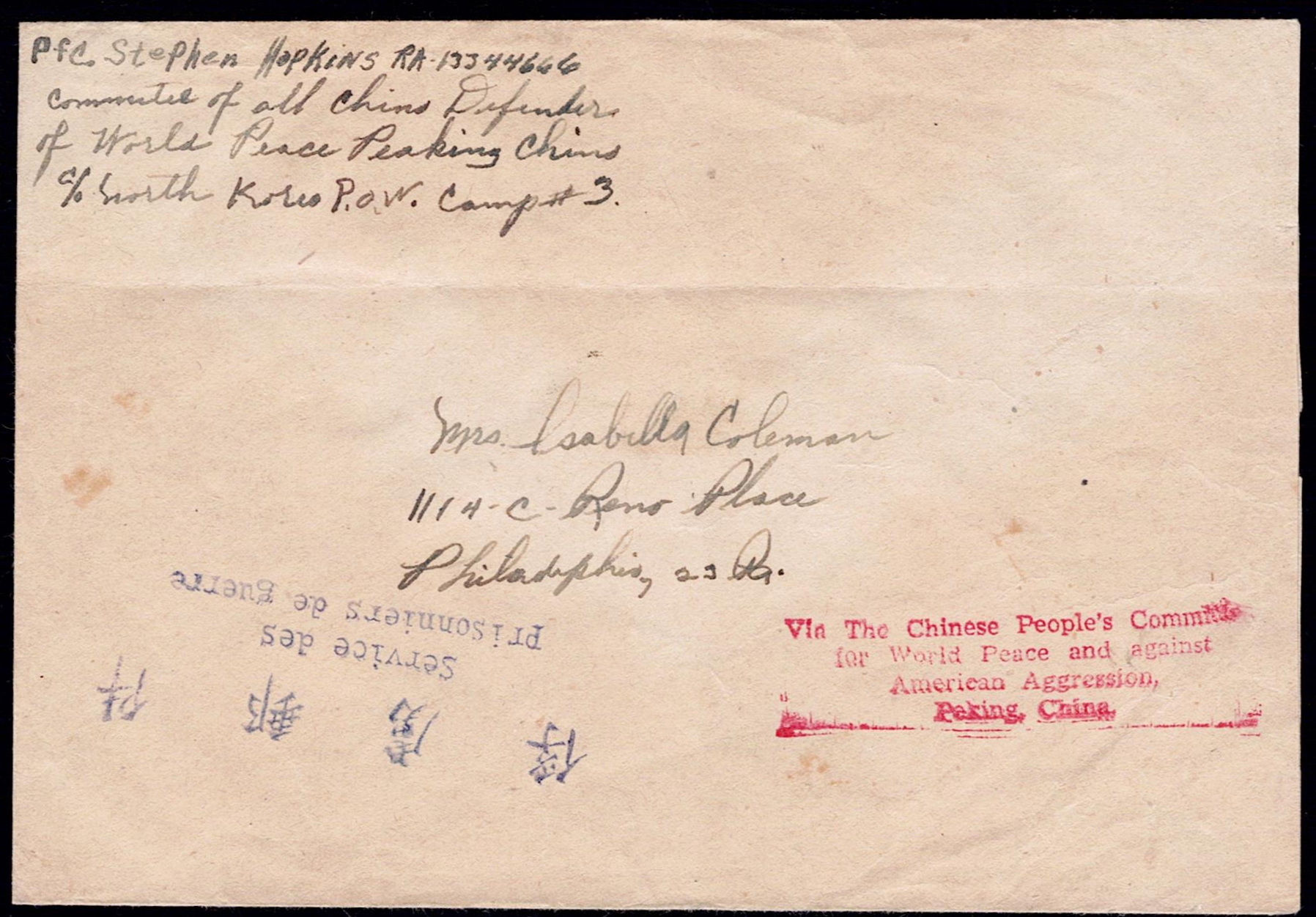
A typical American POW cover sent in 1951, when the Peoples’ Republic of China took over management of POWs and decided to try to use them to “push” Chinese anti-American themes. Note the return address and the red hand stamp trying to pin the blame for the war on America.
The Korean War began in mid-1950 when North Korean soldiers attacked across the 38th parallel in an effort to add by force the Republic of South Korea to North Korean control. To make a long story short, their military was beaten back and United Nations forces invaded North Korea. Their military successes brought them so close to the Manchurian border that the PRC felt threatened, and invaded North Korea to drive out UN forces, and attempt again to overrun South Korea.
The North Koreans murdered many of those they took as prisoners, and treated those they did not kill badly; allowing no contact with the home. When the PRC entered the war, they saw the POWs as an opportunity to promote Chinese propaganda. They took over management of the POWs from the North Koreans, organized a system of permanent POW camps, and determined that it could be in their interest to allow POWs to contact their families.
The first such letters were permitted in early 1951. Letter-writers were told to include “Via the Chinese People’s Committee for World Peace and Against American Aggression” in the return address. Most POWs refused to add the “Against American Aggression” phrase, so the Chinese created a red hand stamp that they added to those few letters (as seen here) that they released.
The letter seen here was written in March, 1951 by U.S. Army PFC Stephen Hopkins who was captured on Feb 6, 1951. He survived 2-1/2 years as a POW, and was repatriated on August 10, 1953, after an Armistice had been signed, ending hostilities.
Please note that this presentation is on Thursday
 are viewable with the free Adobe® Reader®. If you do not have Adobe Reader, click on the image below to download it.